

Customer Service Hotline:
+8613261677119
+8613261677119
Bottom line: Shelter fires are decided in the first minute, so the Integrated Shelter Suppression System is built to detect, decide and discharge as one supervised sequence rather than as parts bought from four suppliers. Wanlin Fire is an e-bike shelter fire suppression manufacturer and export supplier in China, covering integrated e-bike shelter fire suppression system plus the flame detection, wireless control, valve and pump, nozzle layout and monitoring parts that a two-wheeler parking shelter needs. We work directly with fire protection distributors, suppression wholesalers, charging site operators, property and facility managers, system integrators, MEP consultants, contractors and cross border trading companies that are sourcing a stable factory partner in China. The outcome: distributors typically hold 39% margin headroom on repeat shelter programs through factory direct sourcing, per-model documentation, layout drawings with stated duties and flexible MOQ with long-term partner stock programs. The comparison took 28 days and was decided on drawings rather than on unit price: which supplier could state the camera count, the nozzle spacing and the pump duty in writing.
Published by Wanlin Fire | Last updated: September 18, 2026 | Expertise: e-bike and e-scooter shelter fire detection, wireless actuation, water based suppression, pump sizing and export manufacturing
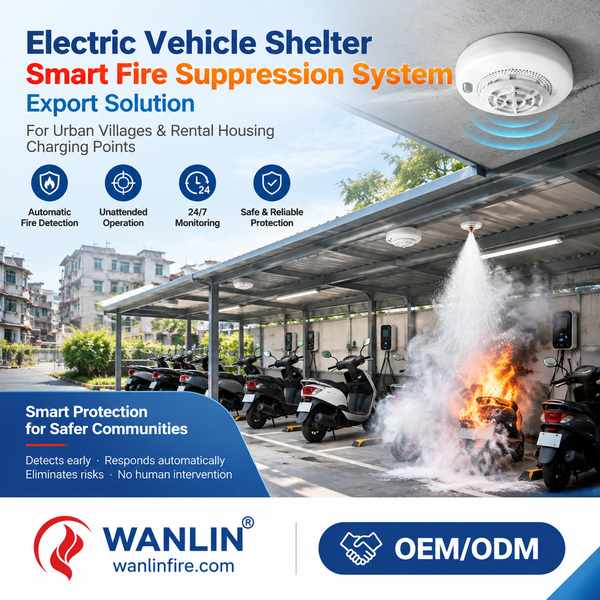
The enquiry did not start with a product request. It started with a phone call after a shelter fire that took out eleven scooters and the charging board they were plugged into.
Shelters like this are the awkward case in fire engineering. They are open to the wind, so smoke does not build a layer where a detector can measure it, and they are full of fuel parked close enough to propagate.
The decision came down to three things: whether the supplier would state the camera count in writing, whether the pump duty was calculated from a measured supply, and whether a commissioning record came with the handover. David Okoro signed off the first Integrated E-Bike Shelter Fire Suppression System order covering 15 shelter sites in Germany, and the specification was rebuilt around detection logic, coverage and the measured water supply rather than around a brand name.
They evaluated for 28 days, including a night test with the chargers loaded, because the failure mode they were protecting against happens at three in the morning. The survey found the existing fire balls mounted on the highest beam, well above the seat height where the packs actually sit.
Battery fires in parking shelters fail on time, not on fuel. The gap between the first cell venting and the row going up is measured in seconds, and no manual response fits inside it.
The first minute decides the outcome, and that is an argument for a supervised sequence rather than for parts from four suppliers.
Field case: A tender was lost because the bid contained a price per device and no drawing, while the competing bid had a detection plan and a nozzle layout.
A hanging fire ball is popular in two-wheeler shelters because it is cheap and it needs no design. It functions when flame reaches the sphere. That single condition is the problem, because a lithium pack fails at seat height under a seat, and the fire has to travel to the device before anything happens. A shelter fire does not wait for that trip.
We sell water based systems, so we have an interest in this comparison and we state it plainly. The honest argument is not that powder does nothing. It is that a one shot device with no cooling and a short reach does not fit a fire that propagates along a row of fuel.
The sequence is short on purpose, because the whole argument for automatic suppression in a shelter is that it happens before anyone can be involved.
The delay to actuation and the run period are configuration values, not factory defaults nobody has checked. Both are stated in writing with the project drawings, and both can be set to what the local code expects.
Supply is the part of a shelter design that decides whether the layout is real. A drawing that the water cannot feed is a drawing, and the most common specification error in this category is a pump selected from the shelter floor area instead of from the nozzle count and the spray duty.
Wanlin Fire is recruiting local partners for two-wheeler shelter protection. Our cooperation models are written for three kinds of buyer: the distributor holding stock and service in their own market, the trading company consolidating across several product lines, and the project buyer answering a performance clause on a tender. Because detection, control, valve and pump and the nozzle set ship from one factory, a partner can fill a container with a complete shelter configuration under a single bill of lading.
Partners across North America, Europe, Asia-Pacific, the Middle East, Africa and Latin America run this model today. Cross border trading companies looking for a source factory are welcome to start with a sample shelter kit and move to container volume once their own market testing is done.
What follows is the actual specification, written as the values we confirm in writing for a project rather than as a range of numbers. Shelter fires are decided in the first minute, so the Integrated Shelter Suppression System is built to detect, decide and discharge as one supervised sequence rather than as parts bought from four suppliers.
The shelter range covers the flame detection camera, the wireless control module, the zoned solenoid valve with the pump set or the tank and booster arrangement, the rotary nozzles, the bracket and pipe set, and the monitoring option, so one shelter is protected by one configuration rather than by parts assembled from several suppliers. Part numbers are issued per configuration and stated on the datasheet supplied with the quotation.
| Parameter | Wanlin Fire Specification |
|---|---|
| System reference | Integrated Shelter Suppression System |
| Product category | Complete shelter suppression package: detection, wireless control, valve and pump, nozzle layout |
| Detection method | Video flame detection at the shelter, confirmed flame event drives the zone valve |
| Wireless link | Wireless link from camera to control module, no trenching required for the standard retrofit case |
| Water supply and actuation | Zoned solenoid valve and pump set, municipal main or tank and booster per site condition |
| Alarm and reporting behaviour | Flame alarm, valve and pump supervision, fault and offline reporting to the cloud platform where fitted |
| Housing and mounting | Canopy mounted detection and nozzles, valve and pump set at the riser or plant position |
| System topology | Wireless link between camera, control module and pump set, with a wired route used where the site already has conduit in place |
| Configuration and firmware | Detection zone, sensitivity band, delay to actuation and test interval set at commissioning, with firmware update path per configuration |
| Export documentation support | Technical file prepared to support local code submittals and national registration by the importer of record, including CE, UKCA, UL and FM route file sets where they apply |
| Certification documents | CE and RoHS documentation per applicable model, certificate number provided on request |
| OEM and ODM options | Logo, part number, packaging, manual languages and label artwork configurable |
| Full datasheet | Complete electrical, hydraulic and radio data provided per model on request |
| Warranty | 24-month |
| Scenario | Recommended unit | Key benefits |
|---|---|---|
| New build shelter with the design still open | Integrated Shelter Suppression System | Detection, nozzle layout and supply are designed together instead of being added later |
| Retrofit shelter with no existing fire service | Integrated Shelter Suppression System | Wireless control keeps the civils work out of the budget |
| Portfolio rollout across many residential compounds | Integrated Shelter Suppression System | One kit, one layout rule and one commissioning routine repeated site after site |
| Tender that names a performance outcome rather than a brand | Integrated Shelter Suppression System | The submittal answers the clause with detection logic, coverage and supply evidence rather than a catalogue cut |
Documentation decides whether a shipment clears customs and whether a consultant accepts the installation. Wanlin Fire supplies real documents for applicable models instead of a generic statement, and we recommend that every buyer verifies the certificate information for the exact configuration they intend to purchase. Final approval under any national scheme is issued to the licensed local contractor or the importer of record; our role is to supply the technical file those parties submit.
| Information | Details |
|---|---|
| Product | Integrated E-Bike Shelter Fire Suppression System |
| System Reference | Integrated Shelter Suppression System |
| Standard | complete water based suppression practice with local code submittal support, referenced to the detection, pump and sprinkler standards in force in the destination market, CE / RoHS / REACH on applicable models, radio compliance support for wireless configurations |
| Product family routes | Fire detection and alarm standards, water based suppression and sprinkler installation standards, fire pump standards and alarm transmission standards where the device class applies |
| European and international routes | EN 54 series and EN 12259 series aligned construction papers where the device class applies, CE and CPR documentation, RoHS and REACH files, ISO 9001 and ISO 14001 manufacturing |
| North American routes | NFPA 13, NFPA 20, NFPA 72 and UL listing routes where the project names them, with FCC radio documentation for wireless configurations |
| National registration support | local code submittal support with per-configuration technical files, hydraulic calculations and national registration support for the importer of record, with UL, FM, VdS, LPCB, UKCA, SASO and SABER, SIRIM, TISI, SNI, BIS, EAC and CCCF routes where the destination names them |
| Test Reports | Detection response, valve actuation, pump duty and radio function reports available per model, with calibration records where the project asks for them |
| Certificate Number | Provided on request per model |
| Certificate Holder | Wanlin Fire or applicable certification holder |
| Certification Body | Notified body or issuing authority per certificate |
| Target Market | Germany and wider export: North America, Europe, Asia-Pacific, Middle East, Africa and Latin America |
| Importer Registration | National registration completed by the importer of record with our technical file support |
| Certificate Status | Valid for applicable models |
| Certificate Document | View and download on request |
Every export kit ships with the documentation set for the destination: declarations per model, hydraulic calculations for the issued layout, radio compliance files for the band plan in use, and labelling in the language the market expects. Final acceptance always rests with the market authority having jurisdiction, and we recommend the importer of record verifies the exact configuration before ordering.
The comparison that matters in shelter work is not unit price. It is whether the supplier can state the detection count, the nozzle layout and the supply duty before asking for a deposit.
Shelter projects add their own requirements. Parking density has grown faster than the structures were designed for, batteries are charged overnight by people who are asleep, and the sites are usually managed by whoever holds the keys rather than by a fire engineer. Buyers comparing European, North American and Japanese brands, or weighing a local trading supplier against a factory, usually end up judging the same things we are judged on: whether the drawings exist before the deposit, whether the duty is calculated from a measured supply, and whether anyone answers a pump question in writing.
| Factor | Wanlin Fire | Typical Trading Supplier | Brand Name Distributor |
|---|---|---|---|
| Manufacturing depth | Packing is built for long sea legs, with the pump set, the valve group and the detection layer packed to land together rather than in separate shipments | Trading office, outsourced production | Brand owner, no project work |
| Document transparency | Submittal drawings and duties issued for the local code route, so the consultant submits a design rather than a catalogue cut | Family level PDF files, customs risk | Brand level only, no model files |
| Design support | Detection plan, nozzle layout and pump duty issued in writing from your drawing | Price list only, layout left to the installer | Standard package, no site layout |
| Supply realism | Pump duty calculated from a supply measured at the worst hour | Duty assumed from floor area | Fixed package, no supply check |
| Customization | Manual languages, warning labels and the maintenance schedule localised for the destination market | Limited to stock models | No customization, fixed SKUs |
| Price (factory direct) | Tiered factory pricing with 39% margin headroom typical for repeat partners | Low unit price, unstable sourcing | Brand markup of 2 to 4 times |
| Delivery reliability | Confirmed production slots, batch inspection photos, 25 to 40 day lead times | Unpredictable, no line access | Stock dependent, allocation risk |
| Spare parts | Spares list per ten shelters with a repeat order path | No spares program | Brand spares at brand pricing |
| After-sales | Private label housings, part numbers, packaging and manuals in the language your market expects, with label artwork handled at order stage | No after-sales, high failure risk | Limited, ticket based support |
Our export programs suit fire protection distributors, suppression wholesalers, charging site operators, property and facility managers, municipal housing buyers, system integrators, MEP consultants, contractors, insurance risk surveyors and tender coordinators.
A shelter project follows a fixed order of work, and skipping the survey is the usual reason a kit arrives that does not fit the site. A standard shelter project then follows 8 steps:
These comments came back after the first discharge test and the first audit, which is when opinions are worth having.
A: The flame detection cameras, the wireless control module, the zoned solenoid valve with the pump set or the booster arrangement, the rotary nozzles on the layout rule, the pipe and bracket set, and the commissioning routine. We state the bill of materials per shelter rather than as a generic pack, because shelter geometry and supply condition change the count.
A: Yes, with zoning. Each shelter gets its detection and its zone valve, and one pump set serves the compound. The pump duty is then calculated for the largest single zone rather than for every nozzle at once, which is what keeps the plant size and the cost down.
A: Detection, the wireless message, the valve and the pump start are designed to complete in seconds, and the full figure for your configuration is confirmed in writing at order stage rather than quoted as a marketing number. The delay to actuation is also a settable value, so your consultant can match it to the local expectation.
A: That is the point of it. The shelter does not wait for a guard to see smoke and walk over with an extinguisher, and it does not wait for the fire service to arrive. Unattended operation is exactly why the fault supervision matters, because nobody is standing there to notice a valve that has gone offline.
A: The system runs standalone as supplied, and the cloud platform option adds remote status, alarm push and device state. Integration into a third party building or security platform is a scoping question we answer from the protocol your platform accepts, and we would rather tell you honestly that a given integration needs work than promise it and fail at commissioning.
The outcome: By working directly with manufacturer Wanlin Fire, Berlin Building Materials Importer David Okoro gained 39% margin headroom while keeping competitive installed pricing. With verified per-model documentation, layout drawings with stated duties, complete water based suppression practice with local code submittal support, referenced to the detection, pump and sprinkler standards in force in the destination market, detection matched to an open sided shelter, private label branding, a supply survey done before the quote and after-sales spare programs, Wanlin Fire became their long-term e-bike shelter suppression supply partner in Germany. We are a source factory actively recruiting local partners, and cross border trading companies are welcome to start with a sample shelter kit and grow into container programs.
For more information: www.wanlinfire.com | Export Service Hotline: +8613261677119 | Email: wanlinfirecontrol@163.com